
Frost doesn’t usually crack a well-built patio on its own. The damage comes from water. When water gets into porous stone, open joints or hollow spots under the slabs and then freezes, it expands and forces things apart. Do that dozens of times over a winter and you get flaking stone, pointing that pops out and slabs that rock or lift.
So the way to stop frost damage is to keep water out and give it somewhere to go. That means choosing paving that doesn’t soak up much water, laying it on a proper sub-base with every slab fully bedded, getting the falls right and doing a few simple jobs each autumn.
How Frost Damages a Patio
There are four main ways winter gets into a patio.
- Water in the stone. Porous stone such as cheaper sandstone soaks up rain. When that water freezes, the surface can flake or peel away in thin layers. This is often called spalling.
- Water in the joints. Cracked or gappy pointing lets water straight in. Each freeze widens the cracks a little more until the pointing breaks up and falls out, which lets in even more water.
- Water under the slabs. Slabs laid on a few dabs of mortar have hollow spaces underneath. Water collects in those voids and freezes, and the slab above cracks or starts to rock. A sub-base that stays wet can also lift as it freezes and drop again when it thaws.
- Salt. Rock salt thrown down on icy mornings soaks into stone and joints, which we come back to below.
When a patio breaks up over winter, it’s usually the bedding, the joints or the drainage that let the water in, not the slabs themselves.
Why Essex Patios Are More at Risk
Chelmsford and most of Essex are built on clay, mainly London Clay and boulder clay. Clay drains slowly, so after a wet spell the water has nowhere to soak away. If a patio was laid on a thin bed of sand straight onto the soil, the ground under it can stay wet for long spells, which is exactly what frost needs. We’ve covered how the same clay moves patios in hot, dry summers, and winter is the other half of that story.
Our weather plays a part too. The Met Office explains that the highest frost risk is on clear, calm nights, and that ground surfaces can drop a few degrees below the air temperature. That means your patio can freeze even when the forecast says the air will stay just above zero.
Then there’s the age of the patio. Plenty of older patios were laid dead flat, with no fall away from the house, or have been built up over the years until they sit too close to the damp-proof course. Water sits on them, soaks in and freezes.
Is Your Paving Frost Resistant?
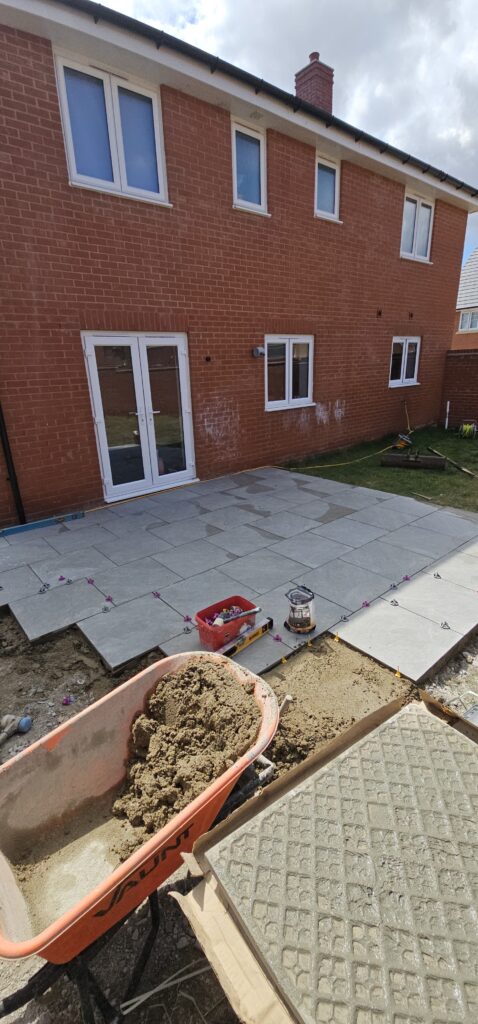
Porcelain. Outdoor porcelain absorbs 0.5% of water or less, so there’s very little in the slab for frost to work on and it doesn’t need sealing. Where porcelain fails in winter, it’s almost always the laying. It’s so dense that mortar won’t grip it well on its own, so the back of every slab needs a slurry primer. Skip it and slabs can come loose, then water gets under them.
Sandstone. Good quality sandstone is frost resistant, but quality varies a lot. Natural stone paving is tested to BS EN 1341, so ask your supplier for the test certificate. As a guide to a good result, Marshalls sets a limit of 1.7% water absorption and no more than a 10% loss of strength after 56 freeze-thaw cycles. Stone that absorbs more can go green quickly and is more likely to suffer frost damage. If a supplier can’t show you test data, think twice. Our porcelain or sandstone guide goes through the other pros and cons.
Concrete block paving. Concrete blocks are tested for freeze-thaw durability under BS EN 1338, so the blocks themselves rarely fail. Problems usually start when the jointing sand washes out or the sub-base underneath stays wet.
How We Build a Patio to Survive Winter
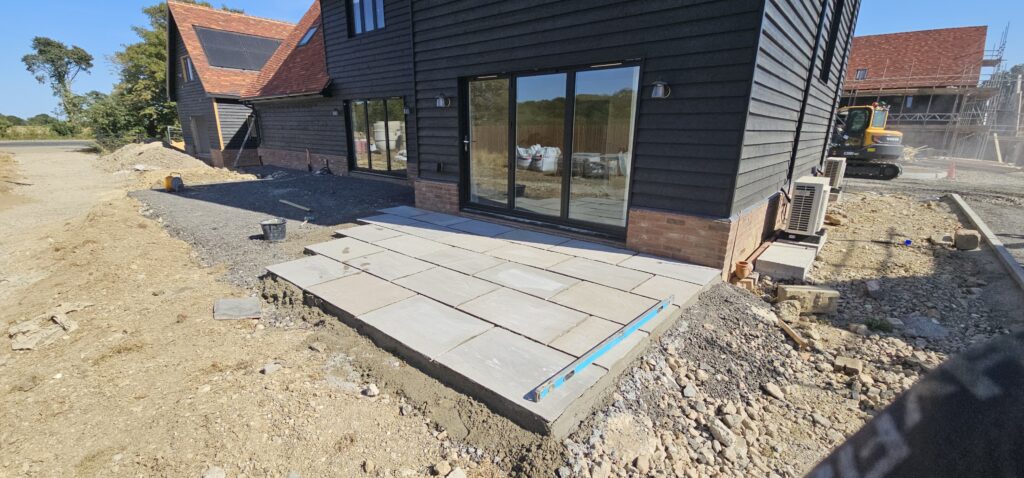
You can’t stop frost, but you can build a patio that gives it nothing to work with. Most of that happens in the parts you never see once the job is finished. When we lay a new patio, we:
- Dig out to firm ground. All the topsoil comes out so the patio isn’t sitting on soft, wet soil.
- Lay a membrane. A geotextile membrane stops the clay working its way up into the sub-base.
- Build a compacted sub-base. MOT Type 1, compacted in layers, gives a solid base that drains and doesn’t hold water against the slabs.
- Fully bed every slab. Each slab goes down on a full bed of mortar, never dabs, so there are no hollow spots for water to collect and freeze.
- Set the falls. We build in a fall away from the house of at least 1 in 80, which is 12.5mm per metre. On a patio 4 metres deep, that’s 50mm from the house to the far edge.
- Keep below the damp-proof course. Building regulations guidance puts the damp-proof course at least 150mm above ground level, so we keep the finished patio at least 150mm below it.
- Give the water somewhere to go. The run-off has to end up somewhere, whether that’s a lawn or border, a channel drain or a soakaway.
- Joint it properly. Joints are filled with a compound that suits the paving, so water can’t get in.
Most of this is groundwork, and it’s the same thinking we use on driveways.
Your Autumn Checklist Before the First Frost
A bit of work now saves a lot of grief by March. Go round your patio and:
- Sweep off leaves regularly. Wet leaves hold moisture against the stone, stain it and make it slippery.
- Look closely at the pointing. Fill any cracks or gaps before winter, because every open joint lets water under the slabs.
- Stand on each slab. If any rock or sound hollow, get them lifted and relaid before the frost gets underneath.
- Clear channel drains, gullies and the ground around downpipes. Make sure no downpipe empties straight onto the patio.
- Lift heavy plant pots onto pot feet so water can drain away and doesn’t sit trapped underneath.
- Clean off algae and moss. If you use a pressure washer, stand well back, keep the jet at a shallow angle of no more than 30° and don’t run it along the joints, or you’ll blast the pointing out.
- Think about sealing natural stone. An impregnating sealer can help sandstone resist water, but the stone has to be completely dry when it goes on. If the weather has already turned wet, it may be better to wait until spring.
Ice and Snow: Salt, Sand and Shovels
When the patio freezes, it’s tempting to grab a bag of rock salt. Many stone suppliers advise against it on natural stone and concrete paving. It can mark the surface, soak into the joints and break down the mortar. The run-off can also harm your lawn and plants. For grip, plain sand is a safer bet. If you want to use a de-icer, check with whoever supplied your paving which products they’re happy with.
To clear snow, use a plastic or rubber-edged shovel, not a metal one. Never chip at ice on a patio, as it’s easy to crack or chip the edge of a slab.
Can You Lay or Repair a Patio in Winter?
Yes, but only in the right conditions. Mortar and jointing products need warmth to cure. Paving mortar manufacturers such as Steintec say not to lay or joint paving below 3°C when the temperature is falling, or below 2°C when it’s rising. Materials must not be frozen and you shouldn’t lay onto a frozen sub-base. Fresh work also needs covering if frost is forecast that night.
We watch the forecast, cover fresh work overnight when we need to and move the laying to another day if a cold snap is coming. The digging out and sub-base can usually carry on in colder weather, so the job keeps moving. Be wary of anyone who’ll lay slabs on frozen ground just to get finished.
Signs of Frost Damage and What to Do
After a cold spell, walk your patio and look for:
- Stone surfaces flaking, peeling or crumbling
- Pointing cracked, loose or missing
- Slabs that rock, sound hollow or have cracked across
- Slabs that have lifted at the edges or dropped
What you do next depends on what you find. Cracked pointing can usually be raked out and repointed. A handful of loose or cracked slabs can be lifted and relaid on a full mortar bed, with new slabs where needed. If the whole patio is rocking, sinking or holding water, the base was probably never right, and the only lasting fix is to lift it and build a new sub-base. If stone is flaking badly all over, it may not be up to outdoor use and replacing it with tested stone or porcelain is the better option. We can sort the landscaping and groundworks around it at the same time.
Common Questions
Is porcelain paving frost proof?
Very nearly. Outdoor porcelain absorbs so little water that frost has almost nothing to work on. When porcelain does fail in winter, look at how it was laid rather than the slab itself.
Is Indian sandstone frost resistant?
Good quality Indian sandstone is, but cheap or untested stone can flake after a few winters. Check the test certificate before you buy, not after.
Does frost damage block paving?
The blocks themselves rarely fail. Topping up the joints with kiln-dried sand and keeping drains clear goes a long way. You can read more about how we lay block paving driveways.
How do I stop my patio getting slippery in winter?
Keep leaves off it, clean off algae before the cold sets in and make sure water runs off rather than sitting in dips. Shaded patios that stay damp all winter turn green fastest. A patio that’s always wet and slippery often points to poor falls or the wrong stone.
Need Help?
If frost has taken its toll on your patio, or you’re planning a new one and want it built to last, we’ll come out for a free site visit and tell you honestly what it needs.
Call Mark on 07747 022565 or Garrat on 07783 549849, 8am to 5pm Monday to Friday, or send us a message.