
Since the end of the summer we’ve had a lot more calls about patios that have dropped, cracked or started rocking. Some of them were only laid a few years ago. In nearly every case, the slabs aren’t the problem. It’s the ground underneath them.
Summer 2026 was the hottest the UK has ever recorded, beating the record set only the year before. Temperatures went over 38°C twice, in June and again on 13 August, when it hit 38.1°C just down the road in London. Out on site some days it felt more like 40°C. July was one of the driest on record, and some parts of the south east went two months without rain. Then the autumn rain arrived. For anyone with a patio on clay, that combination is about as bad as it gets.
Most of Essex Sits on Clay
Chelmsford and most of Essex are built on clay, mainly London Clay and the boulder clay left behind by glaciers. If you’ve ever dug a hole in your garden and hit sticky yellow or grey ground that turns rock hard in summer, that’s it.
Clay behaves differently to sandy or chalky soil. It holds a lot of water, and it changes size depending on how much water is in it.
- When it dries out, it shrinks. In a long, hot spell the clay loses moisture and pulls in on itself. You’ll often see big cracks open up in lawns and borders.
- When it gets wet again, it swells. Once the rain comes back, the clay soaks it up and expands. This is known as heave.
What That Does to Your Patio
As the clay shrinks over the summer, the ground under your patio drops away. The sub-base loses its support and the slabs start to sink, usually more in some places than others. Joints crack and slabs that used to be solid start to rock.
Then the autumn and winter rain soaks back into the clay and it swells again, pushing up from underneath. The trouble is, it never goes back exactly where it was. Some areas lift more than others, so the patio ends up uneven, with dips where water sits and edges that have lifted.
Every hot summer and wet winter repeats the cycle, and each time the patio moves a bit more. That’s why a patio can look fine for a few years and then go wrong quite quickly after a summer like this one.
Trees and Hedges Make It Worse
Trees and big hedges pull a huge amount of water out of the ground in summer. Willow, poplar, oak and leylandii are some of the thirstiest. If you’ve got one near your patio, the clay under that corner will dry out far more than the rest, which is why you often see one end of a patio drop while the other end stays put.
Signs Your Patio Is Moving
- Cracked or broken slabs
- Pointing cracking or falling out of the joints
- Slabs that rock when you stand on them
- Puddles sitting in dips after rain
- A gap opening up between the patio and the house
- Steps, edging or walls pulling away from the patio
Why Some Patios Cope and Others Don’t
You can’t stop clay from moving, but you can build a patio that copes with it. It all comes down to what goes in underneath, which is the part you never see once the job’s finished.
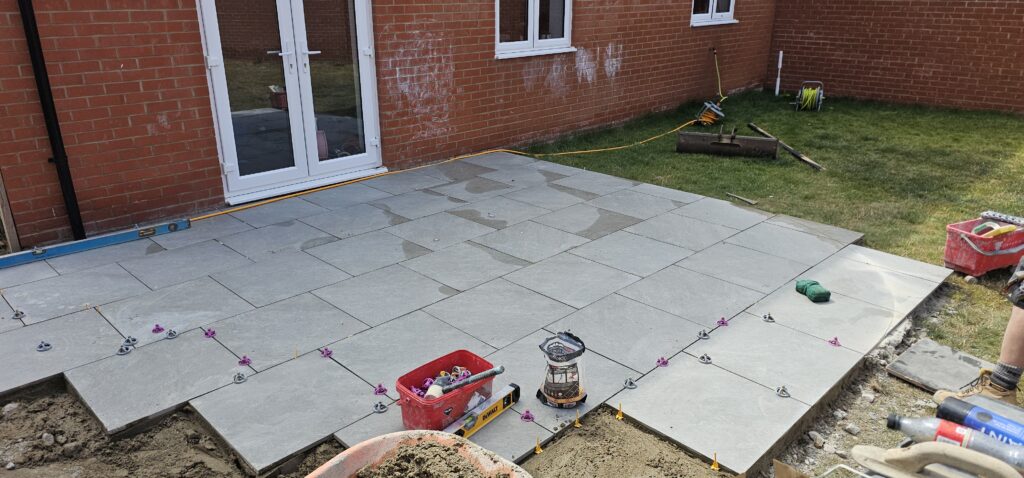
A lot of the patios we’re called out to were laid on a thin layer of sand straight on top of the soil. With nothing solid underneath, the slabs just follow whatever the clay does.
When we lay a patio on clay, we:
- Dig out properly. We take out all the topsoil and go down to firm ground, rather than building on loose soil.
- Put down a membrane. A geotextile membrane keeps the clay from mixing into the sub-base over time.
- Build a compacted sub-base. A good depth of MOT Type 1, compacted in layers, spreads the load and gives the slabs a solid platform that doesn’t react to every change in the ground.
- Bed every slab fully. Each slab goes down on a full mortar bed, not a few dabs, so there are no hollow spots to crack.
- Get the falls and drainage right. Water needs to run off the patio and away from the house, not soak in underneath and keep the clay wet.
- Keep thirsty plants back. We’ll talk to you about where trees and hedges are, and what not to plant too close.
What to Do If Your Patio Has Moved
It depends how bad it is.
- Cracked pointing only: the joints can usually be raked out and repointed.
- A few rocking or sunken slabs: these can be lifted, the bed made good and the slabs relaid.
- Lots of movement across the whole patio: this usually means the base was never deep enough. The only proper fix is to lift it, dig out and build a new sub-base. If the slabs are in good condition, we can often reuse them.
Whatever you do, keep your gutters and drains clear and make sure downpipes aren’t emptying onto the patio or next to the house.
Keep an Eye on the House Too
The same clay that moves your patio can also move your house. If you notice new cracks in your walls as well, especially diagonal cracks around doors and windows, or doors and windows that have started sticking, speak to your home insurer and get a structural engineer to have a look. It’s much better to catch it early.
Need Your Patio Looked At?
We’ve been laying patios and driveways on Essex clay since 1997, and the same rules apply to both. If your patio has dropped, cracked or started rocking after the summer, we’ll come out, have a look and tell you honestly whether it needs a repair or relaying properly. If you’re planning a new one, have a read of our guide to porcelain or sandstone patios too.
Call Mark on 07747 022565 or Garrat on 07783 549849, or send us a message for a free site visit.